
What API integration services involve, how integration differs from custom API development, and how Australian businesses should plan security, delivery and support.
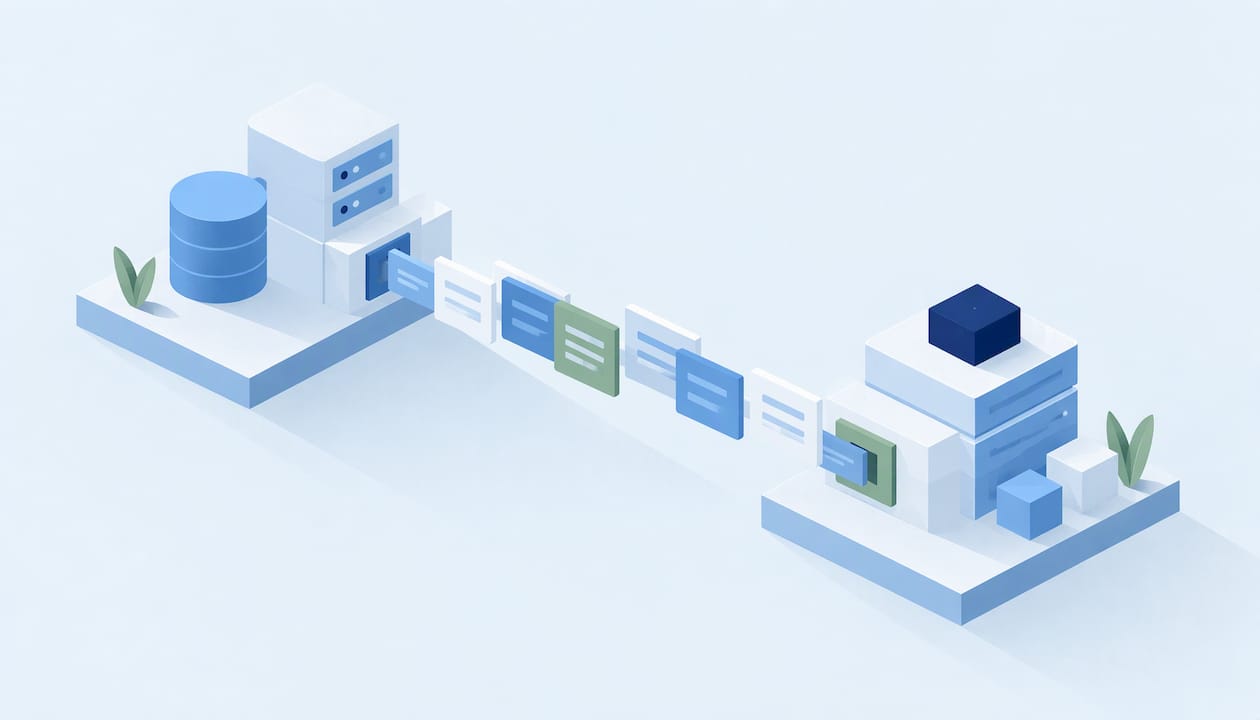
API integration services connect the software your business already runs, such as accounting, ecommerce, CRM, booking and payments, so data moves between them without anyone retyping it. Custom API development builds the interface that makes that connection possible when none exists. Most small and medium businesses need both at different times, and the best results come from one team that designs, builds, secures and then keeps maintaining the connection. At Iceberg CMS, we deliver that as a single full-stack service.
This guide explains what you are buying, how the work runs from first workshop to live monitoring, what to settle on security, and how to brief a provider so the quote you receive is realistic.
An API (application programming interface) is a set of rules that lets one piece of software ask another for data or an action. The Australian Government’s Architecture and Governance Authority describes it as an intermediary layer for transferring data between systems, services and libraries. An integration is a working connection built on those rules: when a customer pays in your online store, the order lands in your accounting package, stock levels update and a confirmation goes out, with no one touching a spreadsheet.
In practice, a provider of API integration services does some or all of the following:
Most modern web APIs exchange data in formats such as JSON or XML, using styles like REST, SOAP, GraphQL or webhooks, with authentication, authorisation, encryption and rate limiting protecting the exchange. You do not need to choose among these yourself. A good provider will recommend one based on what the systems on each side support.
The two phrases are used loosely, and getting them straight shortens the first conversation with any provider.
| API integration | Custom API development | |
|---|---|---|
| What it does | Connects systems that already have APIs | Creates a new API on top of your own system or data |
| Typical trigger | You want your CRM, store and accounts to share data | You want partners, apps or other systems to reach your data |
| Main work | Mapping, authentication, transformation, error handling | Design, backend logic, documentation, versioning |
| Example | Pushing Shopify orders into an accounting platform | Exposing your booking engine so a mobile app and a partner portal can use it |
If the systems you want to join already publish APIs, you need integration. If the software is bespoke, older, or has no usable interface, you need development first, then integration. Many projects blend the two: an internal system gets a new API, and that API is then connected to third-party tools.
The Australian Government’s guidance groups APIs by layer (system, process and experience) and by audience (private, partner and public). That is a useful way to brief a provider. A private API serves your own systems. A partner API is shared with named customers or suppliers. A public API is open to outside developers. Each step outward raises the bar for documentation, security and support.
The strongest cases are rarely technical. They are repeated manual jobs that cost time and introduce errors.
Orders and stock. An online store on Shopify or WordPress passes orders to your inventory and accounting systems, and stock counts update across channels.
Customer data. Enquiries from your website go straight into your CRM with the right tags, and sales activity flows back to marketing.
Payments and billing. Payment gateways, subscription billing and invoicing talk to each other, so a failed card or a renewal triggers the right follow-up automatically.
Mobile and web apps. An iOS, Android or web app reads and writes to the same backend, so staff and customers see one version of the truth.
Reporting. Data from several tools lands in one place, so a weekly report is a query rather than a day of copy and paste.
AI features. Connecting a language or vision model to your own data through an API lets you add search, summarising or document handling inside software you already use.
A useful test: if someone in your business exports a file from one system and imports it into another on a regular schedule, that task is a candidate for integration.
Google Cloud’s developer guide lays out six stages of API development: planning and design, development, testing, deployment, monitoring and maintenance, and versioning. The same sequence works for integration projects. Here is what each stage demands from you and where projects tend to go wrong.

This is the stage that decides cost and timeline. The team documents the systems involved, the data that moves, who owns each system and what happens when something fails. For a new API, a design-first approach uses a specification such as OpenAPI to describe endpoints, data models and authentication before any code is written.
Where it goes wrong: skipping the workshop and starting with code. Hidden requirements, such as a supplier system that only accepts overnight batches, then surface halfway through the build.
The backend logic and connectors are built. Our team works with PHP, Laravel and .NET, along with Shopify and WordPress projects, so the integration can sit inside the stack you already run rather than forcing a rebuild.
Where it goes wrong: building to the happy path only. Real traffic includes malformed data, timeouts and duplicate requests, and the code has to expect them.
Unit tests check individual pieces, integration tests check the connection between systems, and load tests check behaviour at your busiest hour. Test with realistic data, including awkward records such as customers with two addresses or orders with partial refunds.
The integration moves to a hosting environment. Because we also provide hosting, servers and IT infrastructure management, the build and the environment it runs in can be planned together, including capacity, backups and access.
Once live, someone has to watch for errors, slow responses and unusual usage. This is the stage most often left out of the first quote, and it is the one that keeps the integration reliable over years.
Systems change. A supplier updates its API, a payment provider retires an old method, or your own needs grow. Versioning lets the integration evolve without breaking apps and processes that depend on the current behaviour.
An API is a door into your data, so security belongs in the design stage, not the final week.
Baseline controls. The Australian Government’s API standards, written for agencies but a sound benchmark for anyone, require all transport over HTTPS using at least TLS 1.2, validation of every request, and disabling of unused HTTP methods. Apply the same thinking to commercial projects: encrypt data in transit, authenticate every caller, limit each caller to what it needs, and validate all input.
Gateways. The government’s architecture guidance describes API gateways as providing routing, monitoring and security or access control. For businesses with several integrations, a gateway gives one place to manage keys, throttle traffic and see what is happening.
Privacy and breach duties. If your business is covered by the Privacy Act 1988, the Office of the Australian Information Commissioner administers the Notifiable Data Breaches scheme. Coverage depends on factors such as turnover and the type of information you hold, and the OAIC notes that some small businesses with turnover of $3 million or less are still covered, for example health service providers. Check your position with your lawyer or the OAIC, and tell your provider early which personal data will flow through the integration so access and logging are designed around it.
Sector rules. In banking, data sharing under the Consumer Data Right must occur via APIs and in accordance with the standards. If your product touches regulated data, raise it in the first meeting.

The cost of an integration is not only the build. Over time, you will face the problems that sit behind the phrase “API management challenges”:
This is why we pair development with ongoing support, website and app maintenance, and infrastructure management. One accountable team that built the connection is well placed to keep it healthy, and you avoid a handover between a builder and a separate maintainer when something breaks.
Cost and delivery time depend on scope, so the most useful thing you can do is arrive with specifics. Prepare this list before your first call:
The factors that move a quote most are the number of systems, the quality of their APIs, the amount of custom logic between them, and the level of testing and monitoring required. A project connecting two well-documented platforms is a different size from one that needs a new API on a legacy database. Request a scope that names each of these, so quotes can be compared on the same basis.
Pre-built connectors suit simple, common pairings, such as a popular store platform linked to a popular accounting tool. Custom integration earns its place when your process is distinctive: you have bespoke software, unusual approval steps, several systems that must stay in sync, or a need for direct control over how data is handled and secured. In those cases a purpose-built integration fits your workflow instead of asking your workflow to fit the connector, and you own the logic as your business changes.
Iceberg CMS provides API integrations and AI integrations alongside custom development, online software development, mobile app development, web hosting, hosting servers, website maintenance and IT infrastructure audits and architecture. We have more than 10 years in operation and over 200 projects completed, working with PHP, Laravel, .NET, WordPress and Shopify. We serve clients in Sydney, the Central Coast, Blacktown, Newcastle and Maitland, and across Australia.
That range means one team can design the API, build the integration, host it and keep it running. If you have a list of systems that should be talking to each other, talk to us about your integration project and bring the checklist above.

API integration means using the APIs of two or more software systems so they exchange data and trigger actions automatically. Instead of a person exporting and importing files, the systems talk directly. The result is faster processes, fewer errors and a single, consistent record across your tools.
API development creates a new interface for a system, including its design, backend logic, testing and documentation. API integration uses existing APIs to connect systems. If your software already offers an API, you need integration. If it does not, development comes first, and integration follows.
Custom work makes sense when your workflow is distinctive, when you run bespoke or older software, or when several systems must stay in sync with specific rules. It also suits businesses that want direct control over security, logging and how data is handled. A short scoping session usually shows which parts need custom work.
Timelines depend on the number of systems, the quality of their APIs, the amount of custom logic and the testing required. Connecting two well-documented platforms is typically much quicker than building a new API for a legacy system. A planning stage that documents these factors produces a realistic schedule.
Yes. Third-party providers change and retire endpoints, credentials expire, and your volumes grow. Monitoring and versioning keep the integration working as those changes arrive, which is why maintenance is part of the project, not an afterthought.
